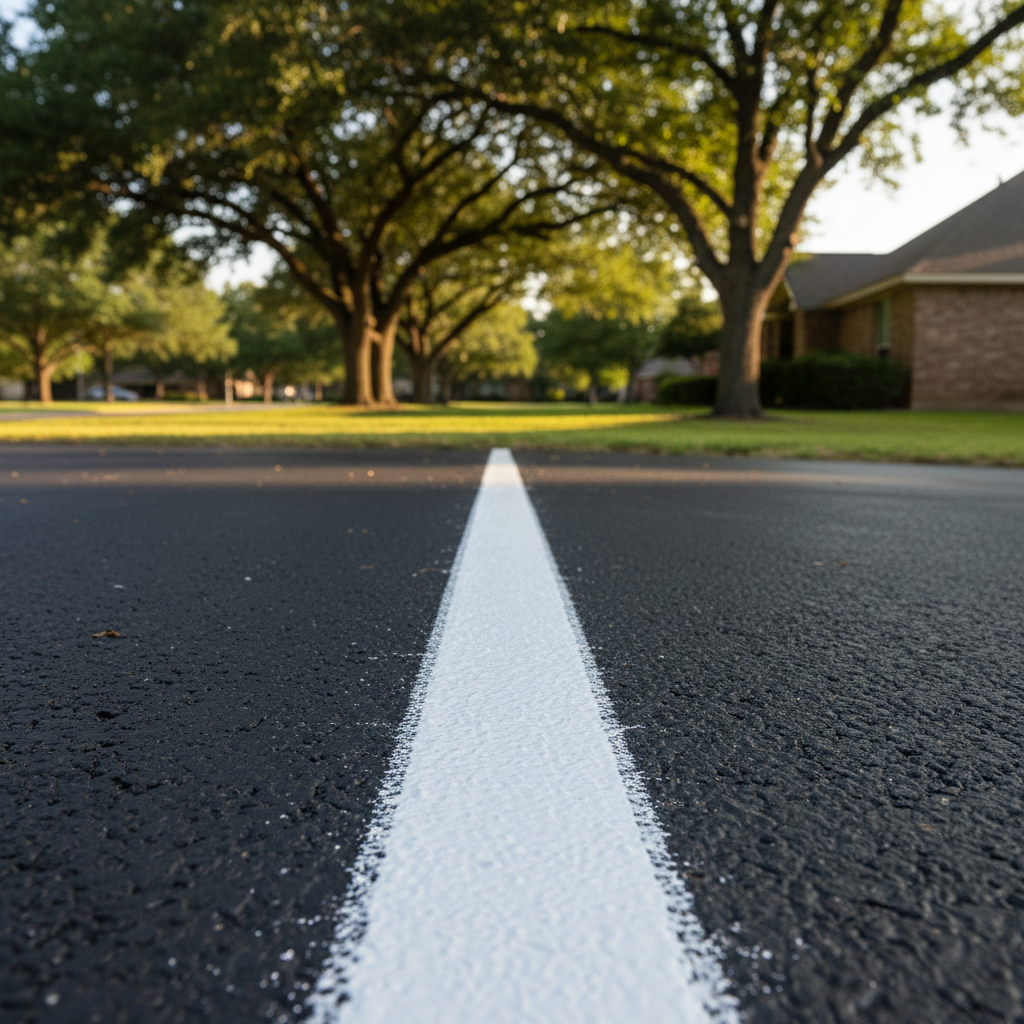
Do I even need striping for my residential driveway? It's not a parking lot.
That's a fair question, and it's one I get a lot from folks with larger driveways or private access roads here in Bryan. For a typical two-car driveway, no, you probably don't need striping. It'd look a bit silly, honestly. But if you've got a long, winding driveway leading to a larger property, or maybe a shared private road with a couple of neighbors, striping can be a real game-changer for safety and organization. Think about it: clear lines can guide visitors, mark off parking spots if you have a lot of guests, or even delineate where the shoulder is on a private road. It helps prevent people from driving off the edge, especially at night or during those heavy Bryan thunderstorms when visibility drops to zero. It's not just for big businesses; it's about making your property safer and more functional.
What kind of paint do you use for asphalt striping? Does it last?
We use specialized traffic paint, not just any old house paint you'd pick up at Lowe's. There are a few different types, but the most common for asphalt are water-based acrylics or solvent-based paints. The key is that they're formulated to adhere to asphalt, withstand vehicle traffic, and resist the elements. Here in Bryan, with our intense summer sun and occasional freezes, durability is crucial. We also often use glass beads mixed into the paint or dropped on top while it's still wet. Those beads are what make the lines reflective at night when headlights hit them, which is a huge safety feature. How long it lasts depends on a few things: the quality of the paint, how much traffic it sees, and the condition of the asphalt underneath. A well-prepped surface with good paint can last several years, but heavy use or a lot of turning and scuffing will wear it down faster. We're talking about a product designed to take a beating.
How long does it take for the paint to dry? Can I drive on it right away?
You're probably eager to get back to normal, I get it. Most traffic paints are designed for quick drying times. Under ideal conditions – warm, dry weather like we often have here in Texas – paint can be dry to the touch in 10-30 minutes. But 'dry to the touch' isn't 'ready for heavy traffic.' We usually recommend staying off fresh striping for at least an hour, and preferably a few hours, especially if it's a critical area or if you're expecting heavy vehicles. If it's humid or cooler, it'll take longer. Driving on it too soon can cause tracking, smudging, or even pull the paint right off the asphalt, and then you've got a real mess and a wasted effort. It's always better to be patient for a little while to ensure a clean, durable finish.
My old stripes are faded and chipped. Do you have to remove them before restriping?
Not always, but sometimes. If the old stripes are just faded but still mostly intact, we can often clean the surface and stripe right over them. This is usually the most cost-effective approach. However, if the old paint is heavily chipped, flaking, or if there are multiple layers of old, uneven paint, then yes, we'll need to remove or at least heavily abrade the old lines. Trying to paint over a really bad surface just means your new stripes won't stick well and will fail quickly. We've got specialized equipment for that, like grinders or power washers, to get a clean slate. It adds to the cost and time, but it's worth it for a job that'll last. You wouldn't paint a wall with peeling paint without scraping it first, right? Same principle applies here.
How much does asphalt striping cost for a private road or larger driveway?
This is probably the most common question I get, and it's tough to give a one-size-fits-all answer because every job is different. Pricing for striping generally depends on a few key factors: the total linear footage of the lines needed, the complexity of the layout (straight lines are easier than intricate stenciling), the type of paint used, and any prep work required like cleaning or old stripe removal. If you need stenciling for things like 'GUEST PARKING' or arrows, that's usually priced per stencil. For a private road, we'd measure out the centerlines, edge lines, and any specific parking areas. We'd also consider if you need reflective beads. The best way to get an accurate quote is to have us come out and take a look. We'll walk the property, measure everything up, and give you a clear, no-surprise estimate. We're Pacific Asphalt Paving, and we pride ourselves on transparent pricing for our Bryan neighbors.
What's the best time of year to get striping done in Bryan, TX?
Temperature and moisture are the biggest factors for striping. You want dry conditions and temperatures that aren't too cold or too hot. For us here in Bryan, that usually means spring and fall are ideal. The paint cures best when it's between 50°F and 90°F. In the spring, after the last freezes but before the brutal summer heat kicks in, is perfect. The fall, once those summer triple-digit days are behind us, is also excellent. You want to avoid striping when it's raining or when rain is expected, as moisture can prevent proper adhesion. And while we can technically stripe in the summer, the extreme heat can sometimes cause the paint to dry too fast, which can lead to issues, or make it difficult for the crew. Winter can work on warmer days, but those cold snaps we get, especially overnight, aren't great for curing. So, aim for those milder months if you can.